

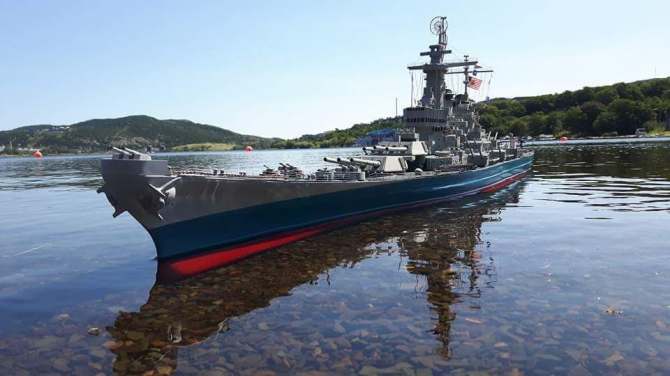
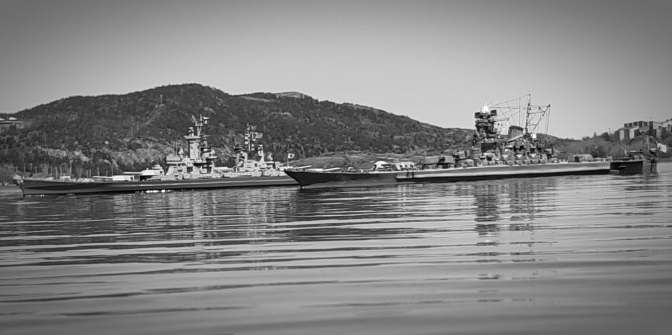
It’s our final selection for the Featured Artist Award that we’ll be distributing this year, and this month we bring you the mind-boggling work of Curt Stokes, an avid RC battleship craftsman, whose craft is as rich with history as it is with detail. His craft isn’t just about functionality either… the ships he and his friends build raise the stakes by doing actual damage, and sink each other as well! Like with previous winners, Curt is not only popular on social media, but also with traditional media outlets as well.

Thank you for time Curt, we love your work. So tell us what go you into building RC battleships, and how long have you been at it?
Curt: What got me into it was my friend, Paul March. He saw a pair of Lindberg plastic ships of the Hood and Tirpitz that I had and decided to motorize them. From there I was not quite sold on RC till the day he stripped down an RC car and stuck it in my Lindberg Tirpitz. That was my first RC experience with a model boat. Prior to that we were floating plastics and shooting them with pellet guns and sinking them. Then we motorized them and let them run freely. We lost some models that way, lol. This began in 1980, so it has been evolving for a long time.
How do you make sure you don’t hit a person on the shore by accident? Do you use protective gear, like body armor?
Curt: For RC Model Warship Combat, the rules are very specific with regard to safety, particularly along the shoreline. Locations are scouted out for suitability as they relate to spectator safety first, and the battler’s secondly. Spectators are behind a roped-off section of the shoreline 50 feet from the battling section. Some clubs offer eye-wear or promote eye-wear when promoting a battling event to the spectators. Inside the rope area, or “PIT,” where the captains are preparing their ships for combat, spectators are invited in to view only if wearing safety goggles. Ships’ cannons adhere to strict safety by having their cannons “pinned” with safety clips inserted through the firing barrels of the model. On shore at the water’s edge, captains are advised to wear pants instead of shorts or rubber boots and overalls, but in the hot climates most just wear normal summer gear . All are aware that BB’s sometimes do bounce off other ships or rocks along the shoreline and they can sting. The power of the Co2 bottles is reduced to low pressure so that the skin cannot be pierced at point-blank range. This is done through pressure regulators that all ships have aboard, which reduce the psi of a paint ball canister to between 120 and 150 psi in most groups. No spectators are allowed to stand along the shoreline during battle or in the pit area during the sortie.
What’s the ambiance of your work environment like? Do you have music or television playing in the background?
Curt: I usually have music. Sometimes just Top 40 stuff. Other times Cassette or CD. Occasionally, just an open line where people call in to complain about things. However, silence works for me too.
Tell us a bit about your physical battleship community, and the online forum you run for it.
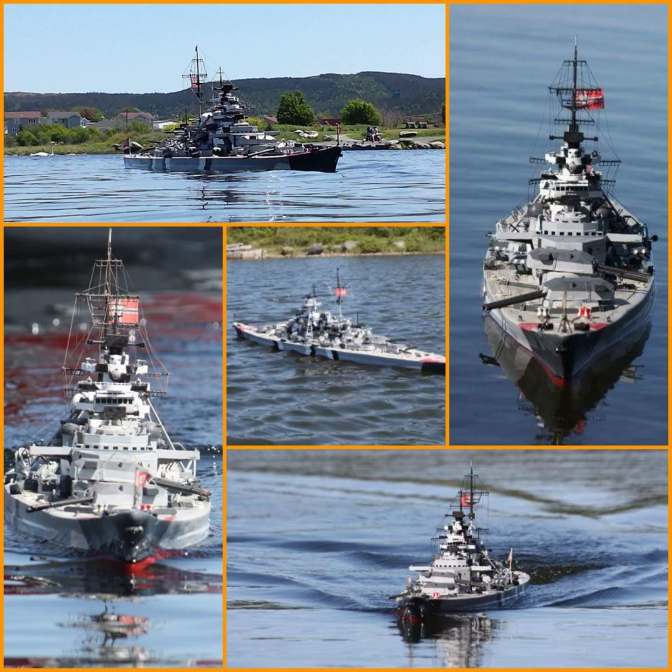
Curt: The community here for battleships is nonexistent, save for me and my fleet and a few members. Which is very surprising as this island, Newfoundland, has a rich, deep maritime history. U-boats hid here in coves, destroyers ran aground and were saved by locals, the convoys left here to cross the dangerous Atlantic to bring supplies to Britain… the list goes on. But for RC, there is nothing. I and my good friend Paul March formed a club here with about 8 to 10 ships, and began running our balsa scratch-build models in the local ponds in the city. It got attention on the local news and my first media exposure was an actual live radio interview at the popular local pond. First time I had a boom mike lowered near the propellers of a Lindberg Bismarck so that the listening audience could hear the props and motors running, lol. Today it is still mostly me. I have a former member of the Nova Scotian group who was involved in our group for many years. I ended up being his best man at his wedding. He has a model of the Nagato which his dad commissioned me to build. I first met him as a little boy at our 1997 show and he became the youngest member of our club, and stayed with us till this day. I have another person with the USS Missouri, which is currently under construction but will be unarmed and built for scale. I have a new member who will be building the SMS KONIG German Dreadnought and the French Battlecruiser DUNKERQUE. Finally, I have another gent who was a member of our group here in Newfoundland and scratch-built a Bismarck, which I rescued years later from a Garbage bin and sailed back aboard our destroyer to Halifax, where it was restored, running again, and sold twice. I met him again recently and showed him the pics and my current fleet. Imagine 30 plus years later and the ships still brought us together. The population in Newfoundland is small and scattered; our harsh conditions and short summer seasons make it difficult to attract people into this hobby. But I keep trying. Online, I run several groups. RC Nautical Republic NL is the Newfoundland online page. Titans Of The Sea: RC Warships, Submarines & Auxillaries is my first online FB page for the hobby. The most popular page right now is the RC Giant Scale Modeling FB page. That includes all types of marine models, and they can be shelf display or full-running RC or manned models. The other online club of which I am a member and have contributed heavily is the RC Model Warship Combat webpage. I have extensive photos, build articles and media contributions there as well. So with the internet, the ability to get the models showcased is better than ever.
Do you build from kits, or scratch-build your ships from plans?
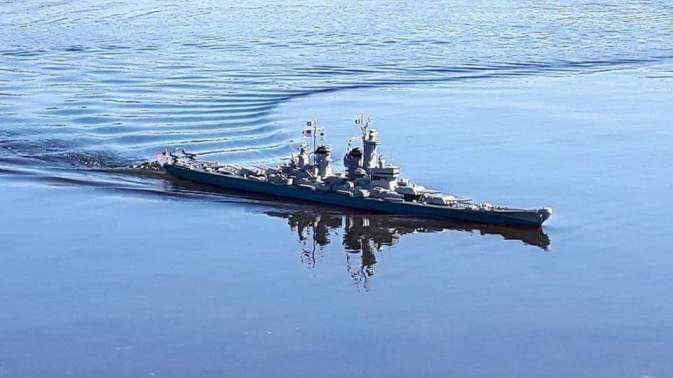
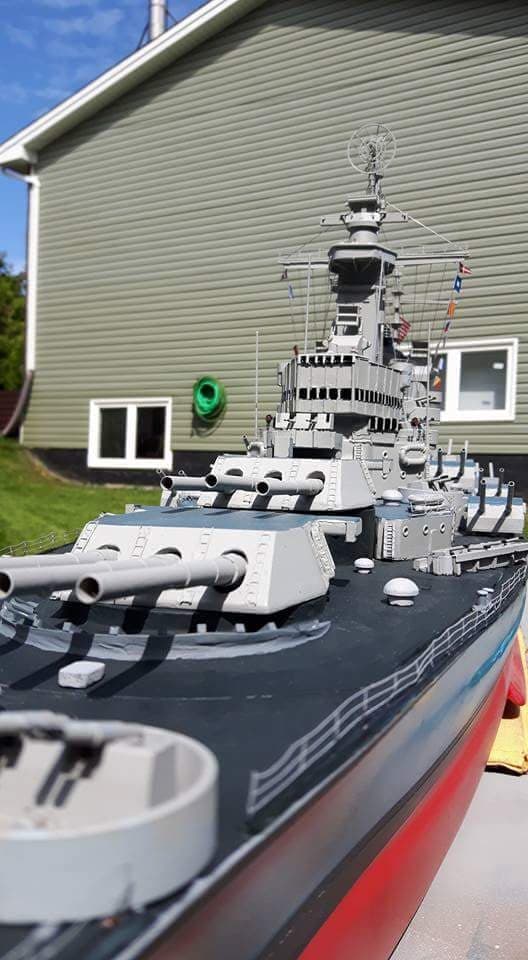
Curt: In the beginning, using 1/700 scale waterline models, my friend had a conversion table and geometry calipers to measure length, width, and height of a ship. The waterline was a guess. We started building with no plans whatsoever. Years later, started photocopying and enlarging plans from magazines like Popular Mechanics. Crude, but it provided a side and top profile to measure details from, but it was very hard to see. Finally after several scratch-builds, I purchased a kit of the Bismarck for RC combat. It was not like a typical ship kit as there were very basic parts and a lot of open suggestion for customization, both exterior and interior. Being a combat boat, the superstructure had basic shapes and little to no detail, as it was designed for being put in harm’s way. So I have both scratch-built kits and Hybrids of both scratch and commercial parts combined overall. The kits save me the time in scratch-building the larger portions of the ship, such as the hull and decks. All are built from plans, and the plans are more detailed and provide three-dimensional drawings. Now, with 3-D printing, those details can be made with little time and effort. The USS Montana has some purchased 3-D parts, but kept to just the bare minimum due to the high costs. Overall, I customize the look and the interior workings of the models.
What is your favorite build so far?
Curt: Favorite build…that is a good question. Each one becomes my favorite. They all presented unique challenges (a.k.a. headaches and frustration), but in the end all presented me with a WOW factor, a “Did I do this?”-kind of thing. Hmmm, Bismarck, I would have to say. Though Montana is an extremely close second.
What is the most tedious aspect of building these ships?
Curt: Sanding….painting…. no… masking for painting. Yes, prepping a model for painting and sanding. Followed by building superstructure details. I built the USS North Carolina for several months in a unheated shed in a snowsuit. I would have my gloves off to make small parts such as the anti-aircraft guns, and within 10 minutes my fingertips were too numb to grasp anything.
So we understand that you’ve beaten cancer… twice. We’re glad you’re still with us, Curt… can you tell us about your struggle there?
Curt: I was diagnosed with non-Hodgkins Lymphoma (fast-growth) in 1998. Grapefruit size tumor in my left chest cavity wrapped around my left rib cage and left arm. Several biopsies and I was on the most aggressive CHOP chemo treatment for six months followed by six months of radiation therapy. I was 34. I didn’t smoke or drink, and I was in top shape. Unknown as to why it happened. However, because I was healthy, I was able to absorb the extreme treatment. It was brutal. I was covered to not expose myself to sunlight, and I took strict measures to isolate myself. I lost all of my hair and sense of taste for food. The outlook was not good and I was not expected to survive. However, I researched the disease and took measures to beat it. Positive attitude and kept my mind on things that made me feel good, like the hobby. Being stuck at home alone was not fun, so I decided to refit my Bismarck and set a goal for relaunching it. I did this in a two-bedroom apartment with in-laws living with me. I had to pretend that I could taste the food using memory and did everything I could to live normal. It was the support of family and friends and the hobby that got me through. That is why I will not part with my Bismarck ever again. It, along with me, survived the journey. In 2005, I was diagnosed again with a slow-growth non-Hodgkins Lymphoma. This one was not treatable. I was on watch and wait for a year. I had tumors all over my body. They could not treat me, so I was advised to go back home to family. That, I did. I had to leave the club and let other people run it. It was very hard as I had spent 10 years building up the hobby in Halifax, Nova Scotia. I suffered depression and was suicidal. I was put on a experimental maintenance chemo where you receive chemo every three months for a couple of years, then radiation. Happy to report I’ve been in remission ever since, and I’ve been able to rebuild my life both in spirit and financially. And of course, I rebuilt the Fleet.
Normally at this point we ask the Featured Artist to give aspiring artists some advice on how they can achieve what they have… but this time we’d like to ask you to give those struggling with a serious illness some words of wisdom, because we think you could definitely give some insight there. Would you encourage them to embark on a hobby, and any other words of encouragement you’d like to give?
Curt: Of course. I have talked to many people with serious illnesses, and I always tell them to fight the fight and look for reasons to keep going . I waged war with my disease and came up with a battle plan with one goal in mind, and that was to win. Find your passion and use that as a spearhead to get you through the toughest times. You have a choice to give up or stand your ground. I knew I was not ready to go yet and I had so much more life to live. I look to people who have been challenged this way and have found their strength to overcoming insurmountable obstacles. You never really know how strong you are till you are challenged with your mortality at stake. I used humor as a powerful tool to get me through each day, and I found that helping people even when I was sick gave me positive feelings about my own situation. My passions for my hobbies and loved ones give me my strength of will. Seek out help and don’t think you don’t need anyone to help you. Nothing wrong with being humble in the fact that you can’t do it all yourself.

So you have more than just RC battleships in your collection then, right?
Curt: Right. People think of me as the battleship guy, but I’ve been building plastics since I was eight years old. I also have RC copters, sci-fi drones, and 1/16th scale battling RC tanks. Nearly as many as my ship collection. I also have RC submarines, which I recently started building. I’ve also been modifying combat model kits for scale-detailed running models, so I am beginning to advance further with accurate detailing. Montana is the first true venture into this. Along with that, I collect comics and Star Trek EAGLEMOSS miniatures, and I have a small Godzilla collection. I love strategy games, and I play video games and games online. So many mini-collections.
Is there a particular artist or work of art that you draw inspiration from?
Curt: OH God yes. Since I’ve been online, there are many people I draw inspiration from. Some are dear friends from waaay back, and others I formed friendships with online sharing our build techniques and work. I love sharing their work on my FB pages. I have some in mind for nominees already. I am always looking at other works by people to learn from and try new things on my projects. I been very fortunate and flattered to have some of my work praised by these people: Robert Lepine is a master plastics builder and award winner. Mark Myers is a master modeler as well. Bob Martin for his outstanding RC submarine work. Steve Neill, Simon Mercs, and TrekWorks modeling on YouTube. These guys have been mind-blowing with what they can do. The list goes on but those are just some of the few. I watch and learn and try to work the same kind of magic they do. I know I fall well short but it is about getting that much closer.
Can you tell us about some of the shows and demonstrations you’ve done?
Curt: First show ever with a model: 1988 with the local I.P.M.S. Society show. I won 1st place for Diorama with the USS ENTERPRISE 1701-D. Got 2nd place for a Starblazers Gamilon Star Cruiser model, and 3RD for a USS IOWA 1/350. That was a start. In Halifax, Nova Scotia, I had my first solo display with Bismarck and Vittorio Veneto trying to introduce RC Combat. I got a lot of strange stares and was shunned from local ponds because they thought I was nuts. Building models and sinking them with armed BB cannons. Really. With recruited members and a club formed, we were on local TV many times over the years, plus our own battling schedule within the club from spring to November and our annual competition in the Canadian Nationals or CAN-NATS . We traveled to Prince Edward Island to participate in their model boat festival. We did a spring show and a fall show every year for 10 years. We were invited to demonstrate our ships for retired veterans in Saint John, NB. The mayor heard about us and passed a motion to allow us to set up the event. We were asked to set up with the Model Train Groups and the Model ship Guild. We did shows outside for large crowds in Windsor, Nova Scotia, for the Sam Slick Festival. We even displayed at car shows and did battles for the crowds. We had a solid reputation and were always active every year. I’ve done demos for TV, and local media had us on short clips related to weather and other events. I’ve done my own displays for schools, and one was for a university project for marketing and advertising, using my Yamato. I’ve been featured in newspaper media myself, along with the models and club models. It has been amazing for sure. I learned a lot about media and how to entertain and recruit. I attended a show with a display that was 60ft by 20ft, which included a tank town for battling, a shooting gallery for tanks and BB cannon ship demos. People always asked where my store was, but they nearly lost their minds when I said I have no store- this is all of my stuff, lol. I have another show to attend very soon, on October 28, the 40th anniversary of the I.P.M.S local chapter. I like to use the ships to help draw in people to an event. I am always asked to come back with the display because of the impact it has on their event.
What’s your most memorable experience throughout all of this?
Curt: 30-plus years of memorable experiences. Very hard to say. Meeting strangers of all types who have a passion for this, in some form or another, at the shows. The many friendships built and sustained to this day. The sinkings and crazy mishaps at battles. The sleepless hours of building ships past midnight and enjoying it. The reactions of people when they see what we do and how we do it. I kept old videos, magazines articles, pictures and the like to remember those times. All of it has been imprinted on me.
Anything else that you would like to add?
Curt: Yes. There was a time when people thought that these kinds of hobbies of building plastic models for display or for RC was a dying trend, and it did seem like that with so much social media going on and the video games online taking over. People thought that skills like that were going to disappear forever. But these hobbies are still going and even more so now than ever before. Online posting of modeling work, and communities of all types of modeling subjects, have allowed an explosion of community and sharing of skills, work, and people showcasing their stuff. Before, most people would not be aware of the models created by an individual. Today, we have access to all kinds of products and markets that enhance and advance the hobby, and I encourage people to use the online medium to learn and explore all aspects of modeling. The viewing public are also being exposed to these works, and a greater appreciation is growing for what we do. No longer being looked at as something to fill your time with or “toys for boys” stigmas.
The hobby of building is in a exciting new era and it awaits your participation. Don’t miss out. Enjoy !!
Cheers
End of interview.
You can view Curt’s full gallery here, and if you’d like to join his club, you can get started here.
Thank you for sharing your work with us Curt, and for helping us to set the standard of craftsmanship we’d like to see here in this segment of the Fun4Change program.
Copyright 2018, Fun4Change.com, and Curt Stokes, all rights reserved.
 Fun4Change